
MEET JANE: EDUCATIONAL THERAPIST, FORMER TEACHER, AND THE PERSON IN THE ROOM WITH THE THERAPY DOG
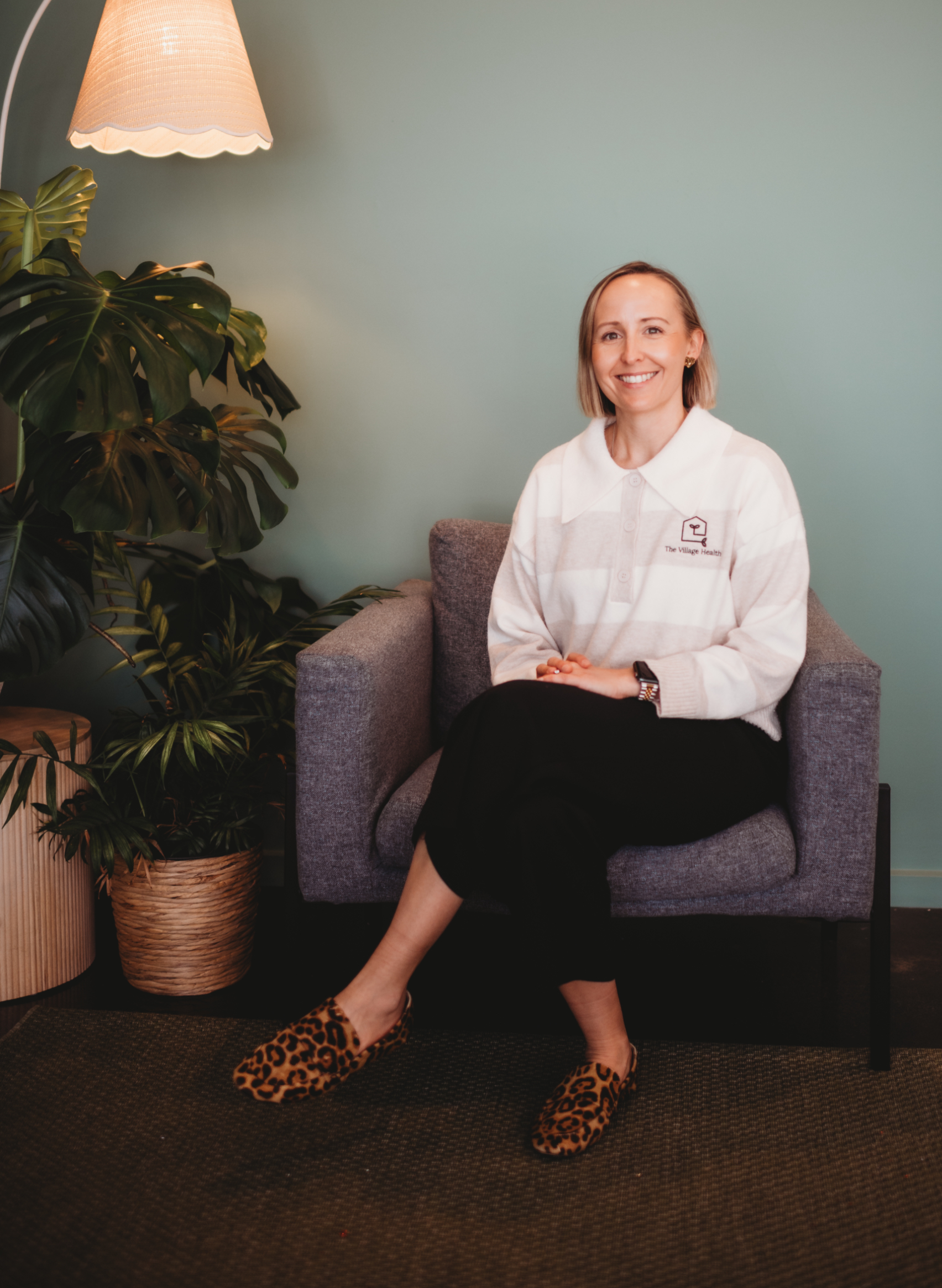
By Jane Sahhar, Educational Therapist - The Village Health, Warragul
If you've ever wondered what actually happens inside an educational therapy session - or what educational therapy even is - this one's for you. I'm Jane, and I work here at The Village Health in Warragul three days a week. I thought it was about time I introduced myself properly.
A little bit about me
I came to educational therapy via a fairly winding road. I spent years as a secondary school teacher - English, Literature and Humanities - which means I understand the school system from the inside. I know how classrooms work, how teachers think, how the pressure builds, and where the cracks are that kids can fall through. I've sat in Student Support Group meetings, written reports, navigated curriculum demands and watched young people struggle in ways that didn't always show up in the data.
I'm also a mum of two, which gives me a completely different kind of understanding - the kind you only get from sitting in the car park before school trying to coax a reluctant kid out of the back seat while also being late for work.
Along the way I've added a lot to my toolkit - Youth Mental Health First Aid, coaching, the Science of Language, mindfulness, mindset, meditation and so much more. These aren't just things I've studied. They're things I genuinely use, with real people, in real sessions.
Outside of The Village Health I love to read, spend time with my family, surf, attempt golf with varying degrees of success, eat dark chocolate and generally spend as much time as possible with our animals. Speaking of which - you may have already heard about Arlo.
The therapy dog in the room
Arlo is our therapy dog, and he is genuinely one of the best things about coming to The Village Health. He joins me in sessions and has a remarkable ability to do what humans sometimes can't - make a nervous kid feel instantly at ease. There is something about patting a dog that drops the walls a little. Arlo has been present for some of the most important conversations I've had with young people, and I'm fairly sure he deserves some of the credit.
At home I also have Louie the cat, and four chickens - Ophelia, Betty, Honey and 6-7. Yes, 6-7 is genuinely one of their names. Long story.
So what is educational therapy, exactly?
It's a question I get asked a lot, and it's a fair one - because it's not as well known as it probably should be.
Educational therapy is not tutoring. It's not purely psychology. It sits in a unique space that bridges learning, wellbeing, confidence and life skills - and it's this combination that makes it so effective for so many young people.
Where a tutor focuses on content - helping a child catch up on maths or English - an educational therapist looks at the whole picture. What's getting in the way? How is this child experiencing school, friendships, their own sense of themselves? What do they need to feel regulated, capable and ready to engage? We work across cognitive and physical skill building, academic support, and counselling and wellbeing - all at once, and all tailored to the individual.
Educational therapy draws on evidence-based approaches within a strengths-based model. That means we start with what a young person is good at and build from there - rather than leading with what's hard. We set goals together, develop strategies together, and measure progress in ways that actually mean something to the child, not just on paper.
I work with primary and secondary school students across a really broad range of areas - anxiety, executive functioning challenges, school avoidance, social difficulties, confidence, study skills, emotional regulation, learning differences, sensory processing, ADHD, ASD and subject-based challenges. Often the presenting issue is just the surface of something deeper, and the work is about getting underneath it in a way that feels safe, practical and genuinely useful in real life.
My colleague Lanara also works as an educational therapist here at The Village Health, with a particular love for early childhood and primary aged children. Between us we cover a wide range of ages and needs - so if you're wondering whether educational therapy might suit your child, there's a good chance one of us is the right fit.
What it looks like when you walk through the door
The Village Health is designed to feel nothing like a clinical setting. When a child or teenager arrives for the first time - often nervous, sometimes reluctant, occasionally dragged in by a well-meaning parent - the environment itself does some of the work. It's warm. It's calm. Arlo is usually nearby.
We always start together. The young person comes in with their parent or caregiver and we have a conversation as a group - getting to know each other, talking about what's been going on, what we're hoping for. There's no pressure and no agenda beyond connection. I want the child to feel like this room is safe before we do anything else.
Then, when the young person is comfortable - and only when they're comfortable - we move into the middle part of the session, which is just the two of us. This is where the real work happens. It looks different every time, because every child is different. Some sessions we're talking. Some we're doing something practical together. Some we're working through a specific strategy or skill. Some days a child walks in and needs something completely different to what I had planned - and that's fine. It's always led by what that particular young person needs on that particular day.
At the end of the session, I bring the parent or caregiver back in. We share what we've been working on, what came up, and what might be useful to carry into the week ahead. Everyone leaves on the same page - and that matters, because the work doesn't stop when the session does.
The take-home
One of the things I do in almost every session is keep a simple working document - what I call a take-home. It's exactly what it sounds like. As we work through things together, ideas and strategies get written down - sometimes by me, sometimes by the young person, often both of us contributing as things come up in conversation. It's a co-creation, not a handout.
At the end of the session that paper goes home with the family. What we talk about in a session only helps if it translates into real life - and the take-home is the bridge between the two. The strategies don't stay in the room. They go to the dinner table, the school morning, the moment a child is sitting in front of homework they don't want to start.
It also means that over time, young people build up a real record of their own insights, strategies and growth. That in itself becomes something they can look back on.
Working with schools and families together
One of the things I feel most strongly about is the wraparound model - the idea that a child is best supported when the adults around them are working together rather than in silos.
I liaise closely with schools. I can help parents understand what their child is entitled to, how to have productive conversations with teachers and wellbeing staff, and how to advocate effectively within a system that can feel overwhelming from the outside. Because I've been on the other side of that table - as a teacher, and as a parent - I can bridge those conversations in a way that feels collaborative rather than confrontational.
I also work closely with the rest of the team here at The Village Health. If a child I'm seeing would benefit from counselling, or if there's a family dynamic that needs support alongside the individual work, we can bring those threads together under one roof. That's the beauty of working within a practice like this one.
Who I work with
I work with primary school aged children through to teenagers, and I love both ends of that range for very different reasons. Kids are wonderfully honest and often just need someone to slow down and really listen to them. Teenagers are complicated and brilliant and frequently exhausted, and connecting with them is genuinely one of the most rewarding parts of my work.
The young people who come to see me are often carrying more than they let on. Anxiety that's been quietly building for years. A learning difference that's never been properly understood. A confidence that's taken a knock somewhere along the way. Social situations that feel impossibly hard. A sense that everyone else has figured out something they haven't.
My job is to sit with them in that, and then very practically and very patiently help them build their way out of it. Everything I do is rooted in confidence building - because when a young person starts to believe in themselves, everything else becomes more possible.
Come and say hello
If you're wondering whether educational therapy might be right for your child, I'd love to have a conversation.
You're welcome to call The Village Health on 03 5625 1778, email hello@thevillagehealth.com.au, or visit thevillagehealth.com.au to find out more.
And if you do come in - Arlo will almost certainly be the first one to greet you.
Jane Sahhar is an Educational Therapist at The Village Health, 62 Smith Street, Warragul. She works with children, teens and families across Baw Baw and the Latrobe Valley.


Comments